"How long will it take to sell my home?"
It is the very first question almost every homeowner asks. When you look at local MLS averages or headline statistics, you might see numbers suggesting homes go into escrow in 35 to 45 days. But in reality, your actual timeline—from the moment you decide to sell to the day proceeds clear your bank account—is dictated by factors that begin long before a photographer steps through your front door.
Across our Southern California communities—from Lakewood (90712/90713) and East Long Beach to Los Alamitos, Cypress, and coastal Seal Beach—the market rewards preparation and penalizes guesswork.
Here is what really dictates your selling timeline in today’s market, how local shifts are affecting closing windows, and what you can directly control to ensure your sale closes on your schedule.
1. What Current Local Market Trends Tell Us
The Southern California market remains resilient, but it is no longer an environment where any house with a sign in the yard receives ten offers in 48 hours. Today’s buyers are diligent, interest-rate conscious, and hyper-sensitive to deferred maintenance.
Here is what median listing prices and average Days on Market (DOM) look like across our primary focus areas:
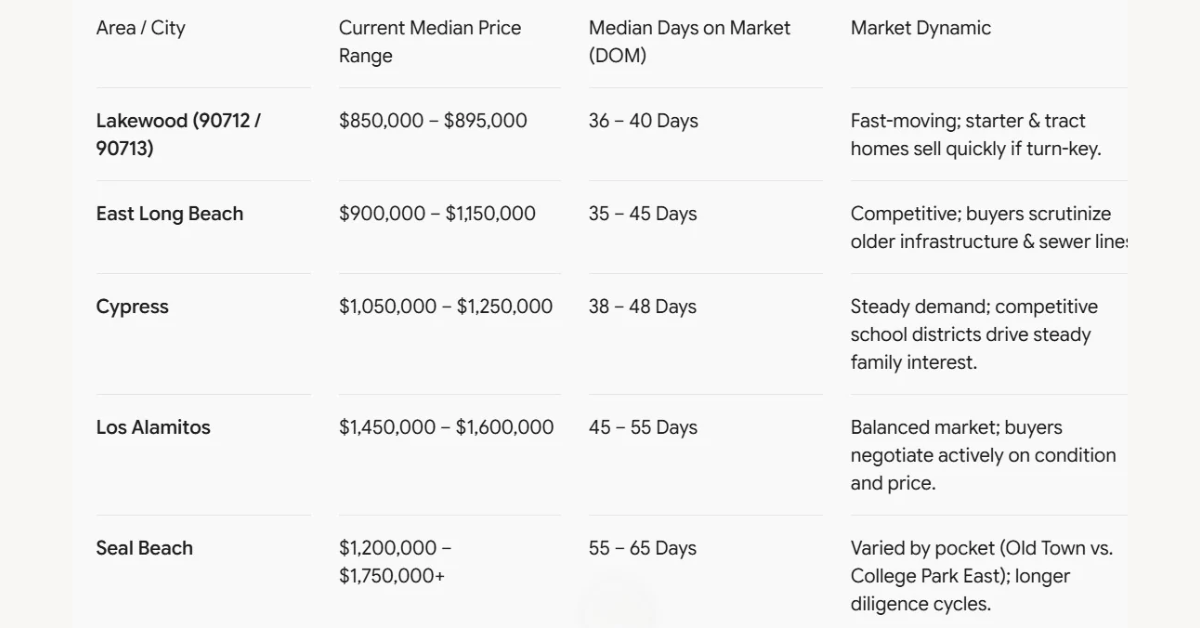
Keep in mind: "Days on Market" measures the time from active listing to an accepted offer (pending status). You must still add 30 to 45 days for the escrow process (inspections, appraisal, and loan underwriting) to get your true closing timeline.
2. The Pre-Listing Inspection: Controlling the Negotiation Before It Starts
One of the largest causes of escrow delays—or deals falling out of escrow entirely—is the buyer's physical inspection report.
When buyers open escrow, they hire inspectors who examine every crawl space, electrical sub-panel, water heater strap, and roof valley. If they uncover major deferred maintenance, buyers typically respond in one of two ways: they demand tens of thousands of dollars in repair credits, or they cancel the contract during their 17-day contingency period. When a sale falls through, your home goes back on the market with an unwanted stigma, and your timeline restarts from day one.
A Professional Advisory Approach:
As part of a strategic home-selling plan, having a professional pre-listing inspection done before placing the property on the MLS gives you total control:
No Blindspots: You know exactly what an incoming inspector will find.
Pricing Accuracy: We establish a real market price that accounts for condition rather than speculative guesswork.
Alternative Strategies (Rent vs. Sell): In a recent scenario, a property owner commissioned an advance inspection and discovered the home required far more capital investment in major systems than anticipated to hit top market value. Because we discovered this upfront rather than mid-escrow, the owner chose to pivot to a high-yield rental strategy instead. Postponing or pivoting from a sale to build long-term wealth through renting is a win when guided by actual facts rather than unexpected escrow pressure.
3. Human Dynamics: Title Clarity & Family Tenants
A home is rarely just a physical structure; it is an emotional and legal asset. One overlooked reason listings drag on or face prolonged delays involves tenant or family dynamics.
When family members occupy a home—whether through informal agreements, inheritance, or multi-generational arrangements—unaddressed expectations can stop a sale in its tracks.
Resolving Title & Transition Hurdles Early:
In another generalized scenario, a homeowner was completely prepared to sell, but an residing family member was hesitant to cooperate with showings and relocation. By bringing a collaborative, mediation-focused perspective to the table, we were able to:
Provide objective verification from the county recorder and title company confirming who was legally on title.
Outline a dignified, transparent move-out timeline that gave the family occupant clear transition steps.
Wait until all parties understood their legal standings and accepted the relocation plan before publishing the listing publicly.
Attempting to force a home onto the market while occupants are unresolved leads to canceled showings, bad listing feedback, and legal roadblocks. Addressing title authority and occupant transitions upfront ensures that once you go live, your timeline is uninterrupted.
4. Emotional Attachment vs. Overpricing Traps
Every homeowner loves their property, and it is natural to place a premium on the memories and personal customizations built over the years. However, testing an artificially high price is the number one cause of prolonged days on market.
The First 14 Days Are Critical: Your home receives 80% of its total digital buyer views within the first two weeks on the market.
The "Stale Listing" Consequence: If buyers in Lakewood or Cypress feel a home is priced 5% to 8% above comparable market sales, they will wait it out. Once a home crosses 45+ days on the market without activity, incoming offers tend to come in below market value because buyers assume the seller is distressed.
Pricing right on target creates competitive tension, often driving multiple offers and shortening your timeline significantly.
The Takeaway: How to Protect Your Selling Timeline
You cannot control Federal Reserve rate announcements or macro-economic shifts, but you have 100% control over:
Your Pre-Listing Due Diligence: Uncovering permit histories and system conditions before buyers do.
Title & Occupancy Preparation: Ensuring deeds, trusts, and resident transitions are legally clear.
Strategic, Market-Driven Pricing: Capitalizing on the first two weeks of buyer interest.